
Dual-Track Curriculum - Graphic Design & Digital Marketing AND Filmmaking & Storytelling
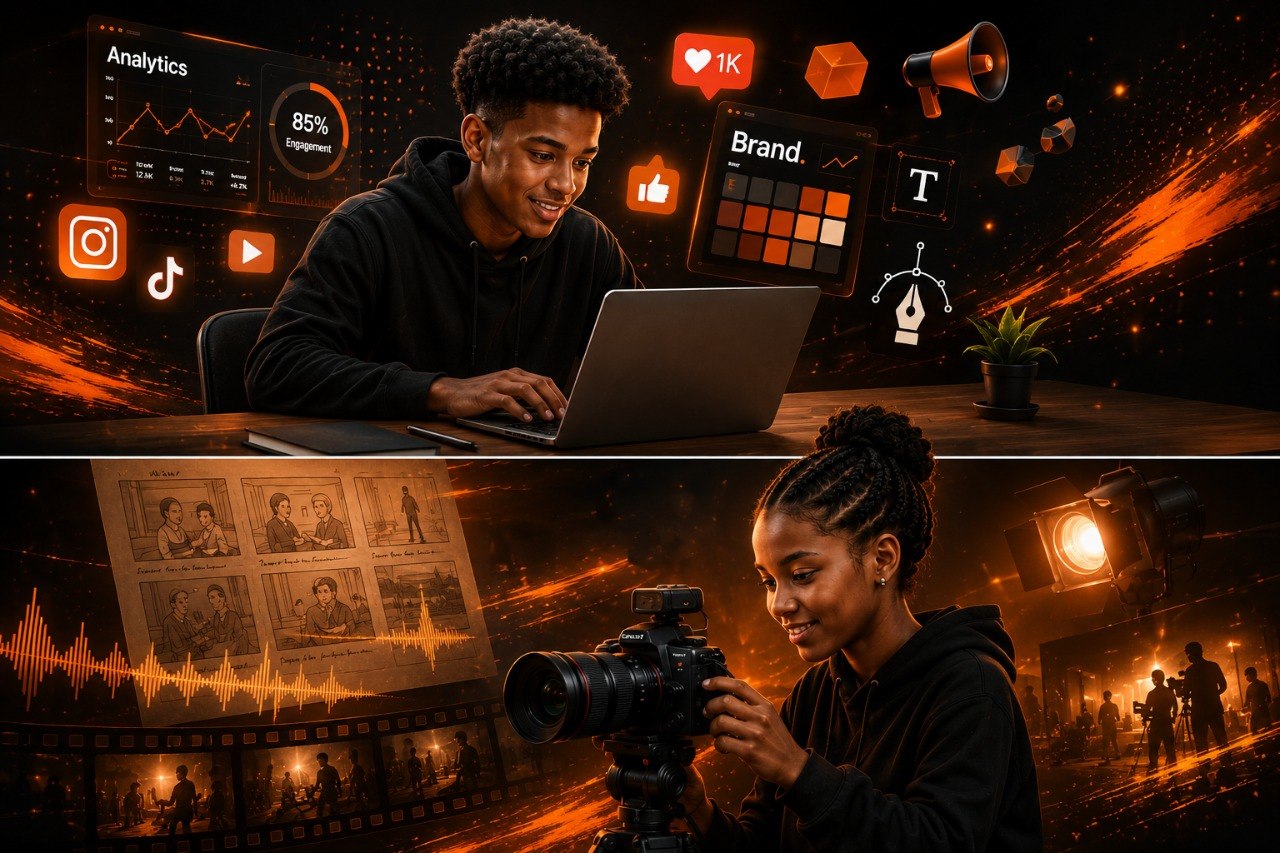
About the Course
Track 1: Graphic Design & Digital Marketing
Schedule: 4 Weeks | 3 Days a Week (Mon, Wed, Fri) | 12 Sessions Total (3 Hours/Session)
Core Objective: Transition from a passive digital consumer into a strategic brand builder using the Academy's professional iMac lab.
Phase 1: Graphic Design Foundations (Weeks 1–2)
Session 1: The Anatomy of a Brand
● Theory: Visual balance, geometric harmony, and spatial contrast. Analysis of why major local and global visual markers stand out.
● Practical Lab: Mastering the digital workspace interface, layer organization, and artboard setup.
Session 2: Color Psychology & Typography Rules
● Theory: Commercial color psychology and emotional cues. Typography parameters: Serif vs. Sans-Serif, font pairings, tracking, and leading rules.
● Practical Lab: Creating synchronized color swatches and implementing professional text layout controls.
Session 3: Visual Hierarchy & Image Compositing
● Theory: The "F-Shape" and "Z-Shape" visual reading patterns. Techniques for intentionally directing a viewer's eye to key informational nodes.
● Practical Lab: Non-destructive background extraction, asset isolation, and blending text elements with complex imagery.
Session 4: Vector Illustration & Commercial Assets
● Theory: Vector vs. Raster environments. Understanding resolution independence and scalability for commercial applications.
● Practical Lab: Pen tool mechanics, geometric transformation, and vector icon production workflows.
Session 5: The Brand Style Guide Compilation
● Theory: The business value of brand uniformity across digital ecosystems. Visual asset management frameworks inside an agency.
● Practical Lab: Technical compilation of design specs, grid systems, and exporting for commercial distribution.
Phase 2: Digital Marketing Frameworks (Weeks 2–4)
Session 6: Target Personas & Digital Funnels
● Theory: Identifying demographic segments in Addis Ababa. The Awareness-Interest-Desire-Action (AIDA) marketing framework.
● Practical Lab: Mapping modern customer conversion pathways and developing target buyer avatars.
● Milestone Assignment: Outlining a 3-stage strategic digital marketing funnel and completing your primary branding assignment from Phase 1.
Session 7: The Art of Commercial Copywriting
● Theory: The psychology behind high-converting headlines. Short-form vs. long-form ad copy. Drafting clear Calls-to-Action (CTAs).
● Practical Lab: Formulating caption frameworks, value-proposition matrixes, and interactive copy text overlays.
● Milestone Assignment: Writing 5 diverse, platform-optimized copywriting hooks targeted at different consumer mindsets.
Session 8: Social Platform Dynamics & Content Pillars
● Theory: Algorithmic distribution systems across major platforms (Telegram, TikTok, Instagram). Constructing Core Content Pillars (Educational, Entertainment, Promotional).
● Practical Lab: Managing creator dashboard configurations, platform insights, and campaign scheduling dashboards.
● Milestone Assignment: Organizing and designing a visual grid strategy layout for a targeted 1-week platform push.
Session 9: Campaign Rollout & Content Calendars
● Theory: Timeline mapping for a product launch. Pacing asset distribution to keep an audience engaged without saturation.
● Practical Lab: Structuring automated content calendars via professional task management tools.
● Milestone Assignment: Building a comprehensive 2-week digital launch calendar matching design graphics with written copywriting assets.
Session 10: The Pitch
● Theory: Presentation mastery and commercial defense. How to explain and back creative design choices and market metrics to corporate stakeholders.
● Practical Lab: Final polishing of presentation slides and exporting high-resolution portfolio files.
Session 11 & 12: Final Project (Capstone Presentation)
Track 2: Filmmaking & Storytelling
Schedule: 6 Weeks | 2 Days a Week (Tue, Thu) | 13 Sessions Total (3 Hours/Session)
Core Objective: Create cinematic art using accessible tools. Students use personal smartphones for production capture and transition to desktop systems for post-production editing.
Phase 1: Pre-Production & Screen Storytelling (Weeks 1–2)
Session 1: The Architecture of a Narrative Screenplay
● Theory: The classic 3-Act narrative structure. Moving from literal dialogue to visual exposition ("Show, Don't Tell").
● Practical Lab: Standard screenwriting software formatting, script structure, and layout management.
Session 2: Visualizing the Script (Storyboarding)
● Theory: Camera mechanics and psychology: Low angles for authority vs. high angles for vulnerability. Utilizing Shot Sizes (Wide, Medium, Close-Up).
● Practical Lab: Transforming written beats into structural shot lists and scheduling sequential film tracking.
Session 3: Mobile Cinematography & Composition
● Theory: The Rule of Thirds, forced perspectives, frame depth, and kinetic camera movement principles.
● Practical Lab: Overriding smartphone auto-settings: Locking focus and manual exposure points. Safe stabilization grip handling.
Phase 2: Production & On-Set Dynamics (Weeks 3–4)
Session 4: Sculpting and Modifying Light
● Theory: 3-Point Studio Lighting principles (Key, Fill, Backlight). Soft light vs. hard shadow diffusion.
● Practical Lab: Manipulating natural window rays utilizing bounce boards and simple diffusion panels.
Session 5: Sound Capture & Audio Integrity
● Theory: Acoustic management. Identifying background distortion risks. Understanding how sound design carries narrative immersion.
● Practical Lab: Placing secondary recording devices for backup microphone tracking and proximity lapel placement.
Session 6: Principal Photography (The Live Set)
● Theory: Set communication rules and active crew hierarchies (Director, Cinematographer, Sound Recordist, Slate).
● Practical Lab: Real-time time management tracking, sun-path alignment, and running consecutive takes on a live set.
Phase 3: Post-Production & Assembly (Weeks 4–6)
Session 7: The Assembly Cut Structure
● Theory: Editorial philosophies. Selecting performance takes. Establishing narrative logic inside the initial timeline layout.
● Practical Lab: Media ingestion, project organizing structures, and mastering basic timeline editing commands.
Session 8: Editorial Rhythm & Pacing
● Theory: Cutting on kinetic action. Integrating B-Roll overlays to cover continuity cracks. Utilizing advanced J-Cuts and L-Cuts.
● Practical Lab: Speed tracking modifications, trim refinement tool options, and visual transition overlays.
● Milestone Assignment: Turning the raw assembly into a polished fine-cut layout by maximizing clip transitions and structural pacing.
Session 9: Color Grading & Ambient Sound Beds
● Theory: Color balancing emotional tones (warmth vs. cold hues). Layering immersive background soundscapes, foley audio, and music beds.
● Practical Lab: White balance balancing, highlight controls, and multitrack background audio leveling.
● Milestone Assignment: Final color matching and audio mastering of the respective group film timelines.
Session 10: The Grand Cinema Showcase
● Theory: Rendering settings and social video specs. Explaining artistic intentions to an active viewing audience.
● Practical Lab: Compression presets, audio normalization boundaries, and batch archive file creation.
Session 11 & 12: Final Project (Capstone Presentation)
Who should learn this course?
- Highscool and Middle School Students
- Young TVET Students
- Youth Passionate about Graphics Design and Filmmaking
- Highscool and Middle School Students
- Young TVET Students
- Youth Passionate about Graphics Design and Filmmaking
- Highscool and Middle School Students
- Young TVET Students
- Youth Passionate about Graphics Design and Filmmaking
What you will learn?
- Graphic Design Foundations
- Digital Marketing Frameworks
- Pre-Production & Screen Storytelling
- Production & On-Set Dynamics
- Post-Production & Assembly
- Graphic Design Foundations
- Digital Marketing Frameworks
- Pre-Production & Screen Storytelling
- Production & On-Set Dynamics
- Post-Production & Assembly
- Graphic Design Foundations
- Digital Marketing Frameworks
- Pre-Production & Screen Storytelling
- Production & On-Set Dynamics
- Post-Production & Assembly
What is required to learn this course?
- Have basic computer literacy
- Those with passion for graphics design and film making
- Be high school or middle school student
- Have basic computer literacy
- Those with passion for graphics design and film making
- Be high school or middle school student
- Have basic computer literacy
- Those with passion for graphics design and film making
- Be high school or middle school student